
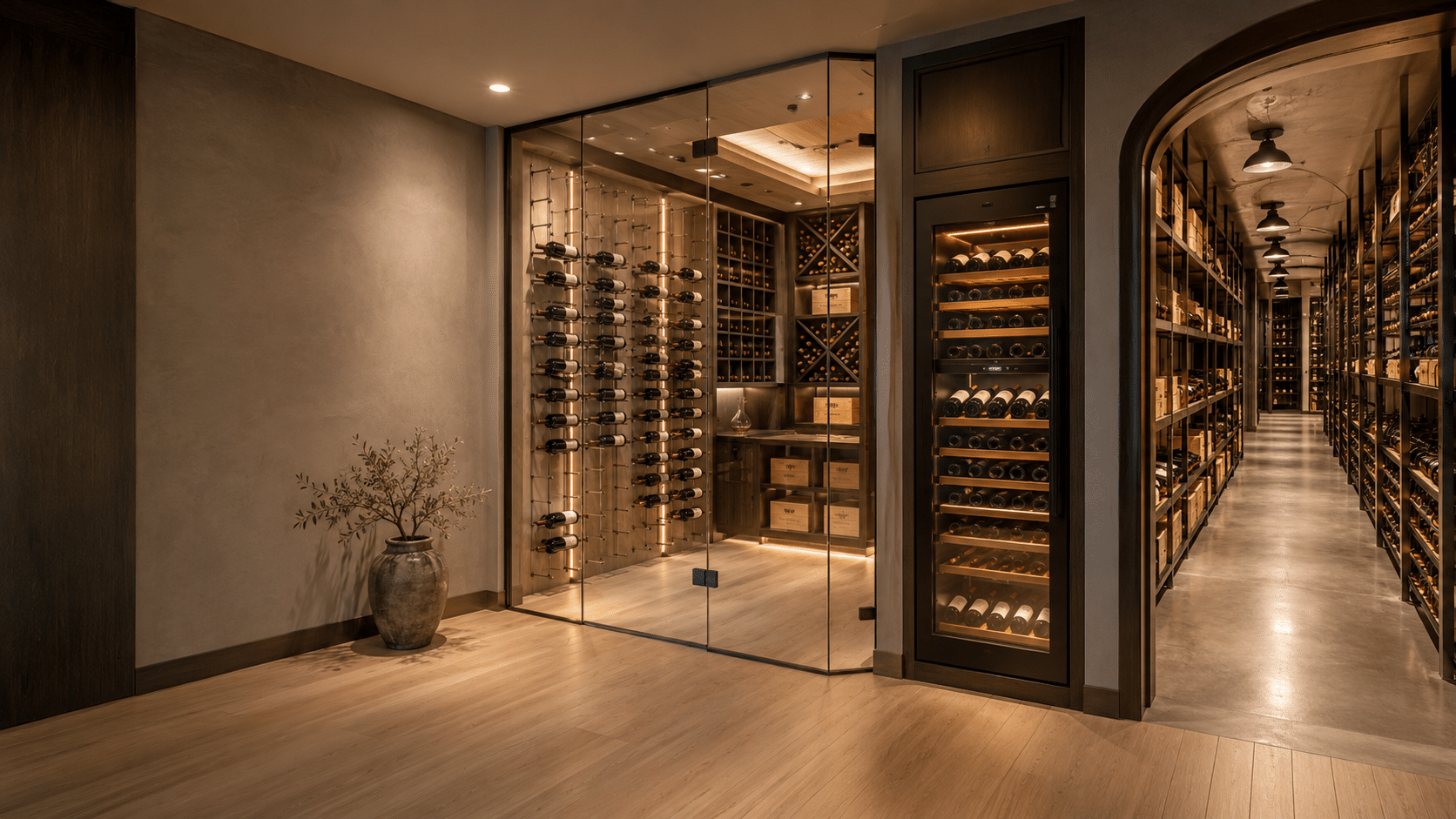
Wine Cellar vs Wine Fridge vs. Off-Site Storage
A growing wine collection eventually creates a practical decision. Do you add another refrigerator, move bottles into a wine storage facility, or create a dedicated cellar at home?
At Some Point, More Refrigerators Stop Making Sense
- Your current wine refrigerator is full.
- Overflow bottles are being stored elsewhere.
- You are considering buying another unit.
- Your collection is becoming harder to organize.
- Long term wine storage is becoming a more important consideration as your collection grows.
Wine Cellar vs Wine Fridge vs. Off-Site Storage: How the Options Compare
Each option solves the capacity problem differently. The better choice depends on how much you value access, flexibility, long-term planning, and integration with the home.
Wine Refrigerator
Compact, accessible, appliance-based storage.
Off-Site Wine Storage
More capacity without dedicating space inside the home.
Custom Wine Cellar
Storage planned around the collection and the home.

Is Your Collection Something You Store—or Something You Want to Live With?
For some collectors, storage is enough. For others, the collection becomes part of how they entertain, choose bottles, and experience the home.
A thoughtfully designed cellar can turn wine from something kept behind an appliance door into a deliberate art piece that feels connected to the surrounding space.
The goal is not simply to store the collection, but to give it a place within the home.
The collection becomes part of the home—not an overflow problem hidden somewhere inside it.
This is the point where the decision stops being only about bottle capacity. It becomes a question of how you want to access, organize, share, and experience the collection you have built.
Proper Storage Is About More Than Finding Space
For collectors considering how to store wine properly, capacity is only part of the equation.
Temperature
Temperature is one of the biggest factors in how well a collection holds up and how wine ages over time. What temperature should wine be stored at and wine storage temperature consistency matters more than most people expect going in.
Humidity
Appropriate wine storage humidity is another part of responsible cellar planning and overall wine preservation.
Protection
Owners of larger or particularly valuable collections may also want to ask their insurance provider about wine collection insurance and appropriate documentation or coverage.
These considerations are one reason dedicated cellar design should address climate control early. The cooling approach, enclosure, and surrounding construction all need to work together rather than being treated as separate decisions later in the project.

When Off-Site Storage Is Still the Better Choice
A custom cellar is not the right answer for every collector.
Professional wine storage can be a practical choice when the primary concern is capacity and there is no desire to dedicate space within the home.
- You need more capacity without using interior space.
- You do not need frequent access to every bottle.
- Display is not a priority.
- You prefer a dedicated wine storage locker rather than adding more appliances at home.
The wine is no longer immediately available at home, and storage typically remains an ongoing expense rather than a completed home project.
For some homeowners, that is entirely reasonable. For others, especially those who want the collection close at hand, it can begin to feel disconnected from the way they actually enjoy wine.
A Few Questions Usually Make the Right Direction Clear
If capacity + simplicity lead
A wine refrigerator or offsite wine storage may be sufficient.
If capacity + access + design all matter
A custom wine cellar may be worth exploring.
If You Are Already Planning the Home, Plan the Cellar With It
A wine cellar can be designed for a new build, a remodel, or an existing home. In every case, the goal is to make sure the cellar feels intentional within the space and that the design, construction, and climate-control requirements are coordinated from the start of the cellar project. In practice, that means the same three groups should be working from the same plan to make sure the wine cellar does not fail.

Homeowners
Define how the cellar should function, how often the collection will be accessed, and how prominently it should appear within the home.
Architects & Interior Designers
Coordinate the cellar with the proportions, materials, sightlines, finishes, and overall design language of the surrounding space.
General Contractors & Project Managers
Coordinate construction sequencing, infrastructure, and the requirements needed for proper installation.
How the Costs May Differ
- Wine Refrigerator: Primarily an appliance purchase, with ongoing energy and maintenance costs. Expanding storage capacity typically means purchasing additional units.
- Off-Site Storage: Involves recurring storage fees for as long as the collection remains in the facility. Costs may increase as the collection grows or additional services are needed.
- Custom Wine Cellar: Requires a larger upfront investment, but the primary construction costs are incurred once. Design, construction, racking, finishes, insulation, and climate control are planned as part of a complete project, with ongoing energy and maintenance costs to consider.
“The question of wine cellar vs wine fridge vs off-site storage becomes more important once the collection outgrows the solution that worked in the beginning.”
You are deciding what kind of place your collection should have in your home.
Another refrigerator may be enough. A professional storage facility may be the most practical answer. Or the collection may have reached the point where a dedicated cellar makes more sense for the way you want to store, access, and enjoy it.
When another refrigerator feels temporary and off-site storage feels too removed, you are no longer simply deciding where to store wine.
It may be time to think about what it would look like to give your collection a space of its own—with you, at home.
Discuss Your Collection →